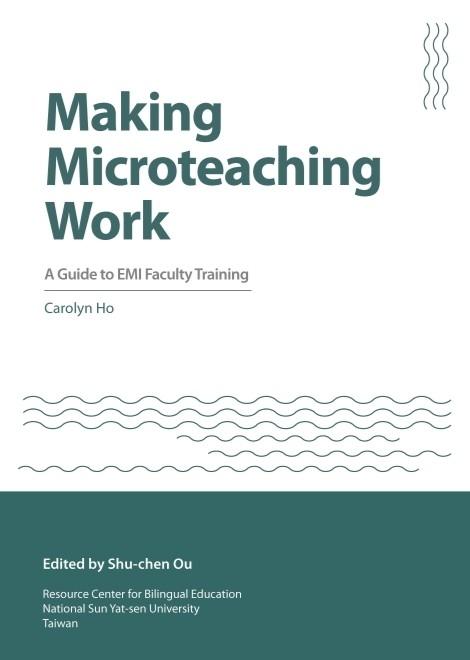
RCBE Publishes Making Microteaching Work: A Guide to EMI Faculty Training — E-Book Now Available
The Resource Center for Bilingual Education (RCBE) at National Sun Yat-sen University (NSYSU) has published Making Microteaching Work: A Guide to EMI Faculty Training. The e-book is now available to read on the RCBE website.
The author, Dr. Carolyn Ho, is Professor of English for Speakers of Other Languages at Lone Star College-CyFair in Texas. She is a former Fulbright Scholar and a U.S. Department of State English Language Specialist, and she has led EMI and CLIL training workshops across Taiwan. The book is edited by Dr. Shu-chen Ou, Vice President for Academic Affairs at NSYSU.
The book grew out of NSYSU's 2022 online synchronous EMI microteaching program, run in collaboration with the U.S. Department of State English Language Programs. It was the first program of its kind in Taiwan. Over ten weeks, 38 faculty members from universities across southern Taiwan, in fields from the arts and humanities to medicine and STEM, took turns teaching short lessons. Each lesson was followed by a dialogue with the trainer, peer feedback, and self-reflection, so participants built their EMI teaching skills step by step. Dr. Ho turns this experience into a practical guide that other institutions can adapt.
The book has three parts and eight chapters:
- Part 1 explains Taiwan's Bilingual 2030 policy and the Program on Bilingual Education for Students in College (BEST), and why microteaching is central to EMI faculty development.
- Part 2 is a hands-on manual for the planning, implementation, and reflection stages. It covers 15- to 20-minute mini lessons, presenter–trainer dialogue, open feedback, and the reteach episode.
- Part 3 covers common challenges, how to adapt training to different disciplines and to undergraduate or graduate courses, and how to make microteaching part of an institution's teaching culture over the long term.
The appendices include a sample lesson plan template, an observation form, and question banks for audience response and post-lesson self-reflection. All of them can be used directly in faculty training.
The book is endorsed by Dr. LIN Po-Chiao, Chief Secretary of the Ministry of Education; Dr. Yuh-Fang Chang, Vice President for Academic Affairs and Professor of Foreign Languages and Literature at National Chung Hsing University; and Dr. Gina Wen-Chun Chen, Associate Professor of Foreign Languages and Literature and Director of the Center for Language Studies at National Chung Cheng University. We invite EMI instructors, faculty development professionals, and anyone interested in microteaching to read it.
📖 Read the e-book: https://emi-tdc.nsysu.edu.tw/highlights/category/publications
Book Information
Title: Making Microteaching Work: A Guide to EMI Faculty Training
Author: Carolyn Ho
Editor: Shu-chen Ou
Publisher: Resource Center for Bilingual Education, National Sun Yat-sen University Year: 2026
ISBN: 978-626-7684-04-7