Cross-Institutional Faculty Community Application Guidelines
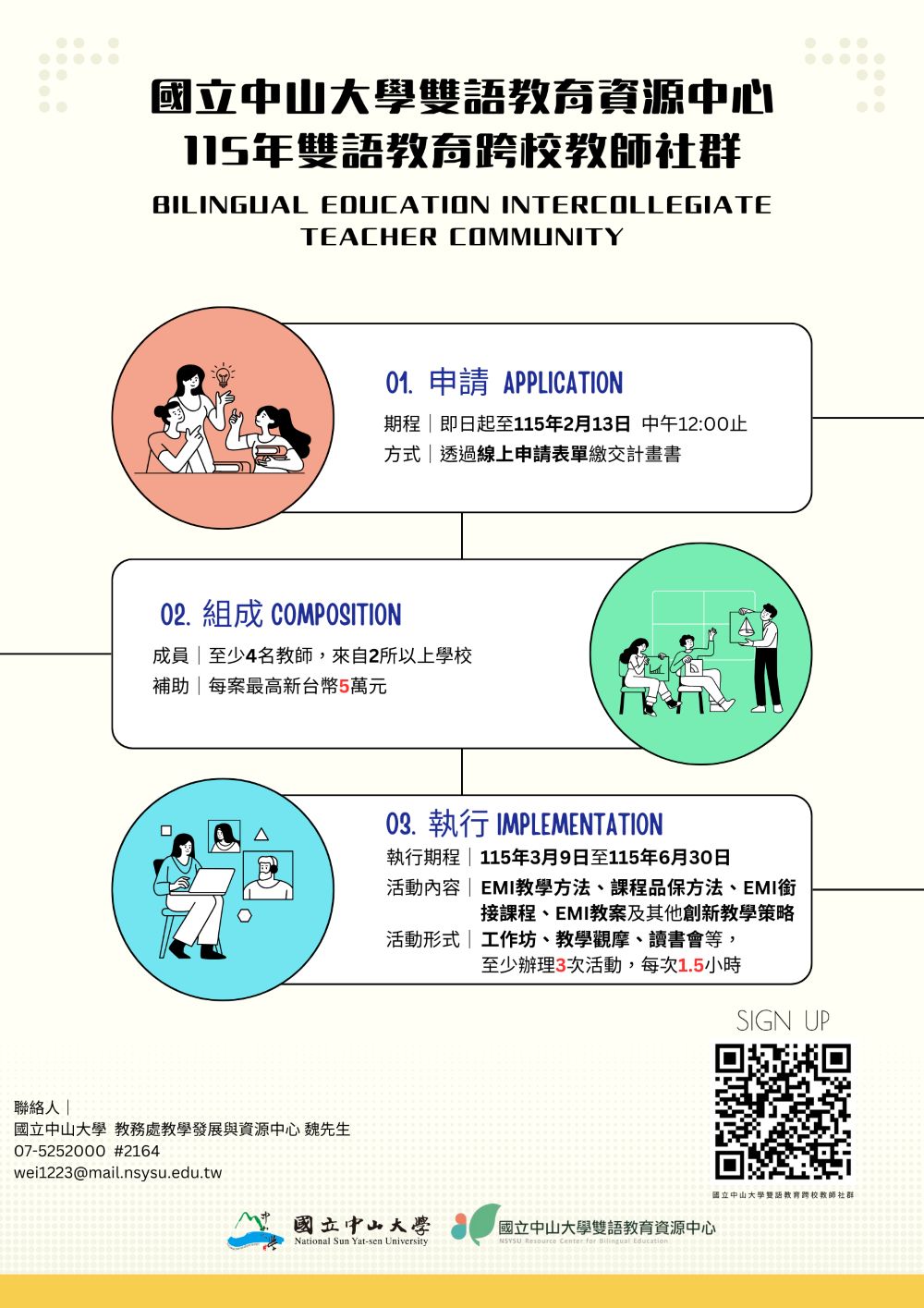
To support the Ministry of Education’s EMI Bilingual Education Resource Center Project, NSYSU invites faculty from universities and colleges across Taiwan to establish Cross-Institutional Bilingual Education Faculty Communities. Through broad and diverse exchanges, the program aims to build a supportive network for bilingual education and enhance faculty teaching knowledge, skills, and confidence..
- Application period: Now through 12:00 noon, February 13, 2026 (Friday)
- Funding: Up to NT$50,000 per project.
- Execution period: March 9–June 30, 2026
- Application form:https://forms.gle/dgb8ZjXE2GHj65jL7
- Please refer to the documents below for the guidelines and proposal template.
-
Attachments
- [Guidelines] 2026 Cross-Institutional Bilingual Education Faculty Communities
- [Reimbursement] 2026 Cross-Institutional Bilingual Education Faculty Communities
- [Proposal Template] 2026 Cross-Institutional Bilingual Education Faculty Communities
- [Activity Record Form] 2026 Cross-Institutional Bilingual Education Faculty Communities
- [Final Report] 2026 Cross-Institutional Bilingual Education Faculty Communities
- Contact:
Ms. Lin
Teaching and Learning Development and Resources Center, Office of Academic Affairs
Tel: +886-7-525-2000 ext. 2171
E-mail: connie.lin@mail.nsysu.edu.tw